Industrial Deaminase Enzyme Cheese Process Guide
Process guidance for industrial deaminase enzyme cheese use: dosage, pH, temperature, QC, pilot trials, COA/TDS/SDS, and supplier qualification.

Protein deaminase helps cheese manufacturers tune protein charge, hydration, melt behavior, and emulsification in controlled dairy and hybrid cheese processes.
Why Cheese Processors Use Protein Deaminase
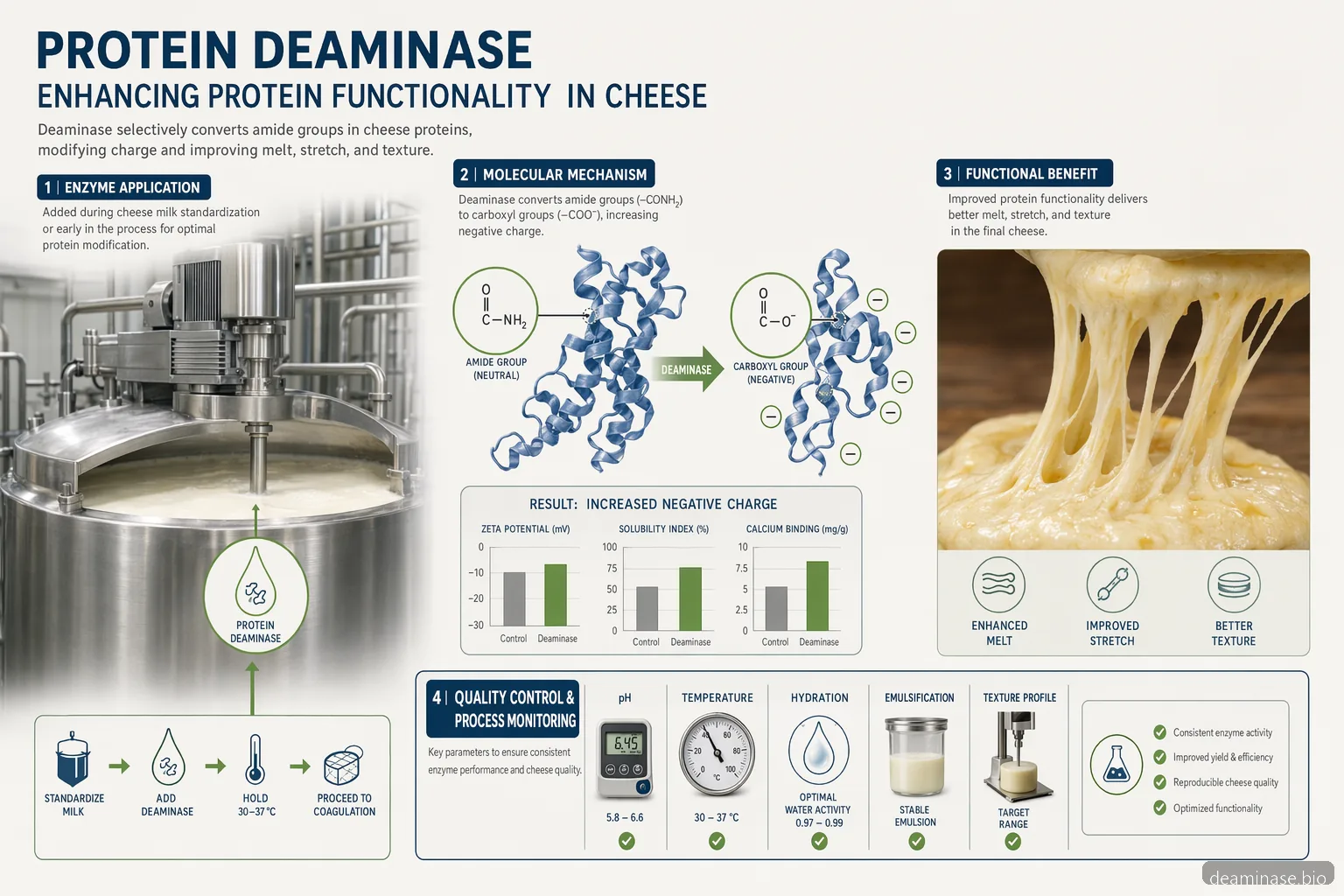
Industrial deaminase enzyme cheese applications focus on targeted food protein modification rather than medical or supplement use. Protein deaminase, also called protein glutaminase in many technical documents, converts glutamine residues in proteins to glutamic acid residues and releases ammonia. This increases negative charge on the protein surface, which can improve water interaction, dispersion, and emulsifying performance. In cheese systems, the enzyme may be evaluated for processed cheese, cheese spreads, recombined dairy bases, plant-dairy hybrid cheese, and protein ingredients used before cheesemaking. The main value is process control: changing protein functionality without relying only on salts, shear, or formulation changes. Effects depend strongly on substrate, heat history, calcium balance, pH, and enzyme activity. For that reason, industrial protein deaminase cheese trials should begin with bench screening and move to pilot validation before production adoption.
Supports functionality tuning in dairy and hybrid cheese bases. • Most useful where protein hydration, emulsification, or melt behavior limits performance. • Should be validated against the exact cheese formula and process.
Practical Process Conditions for Cheese Trials
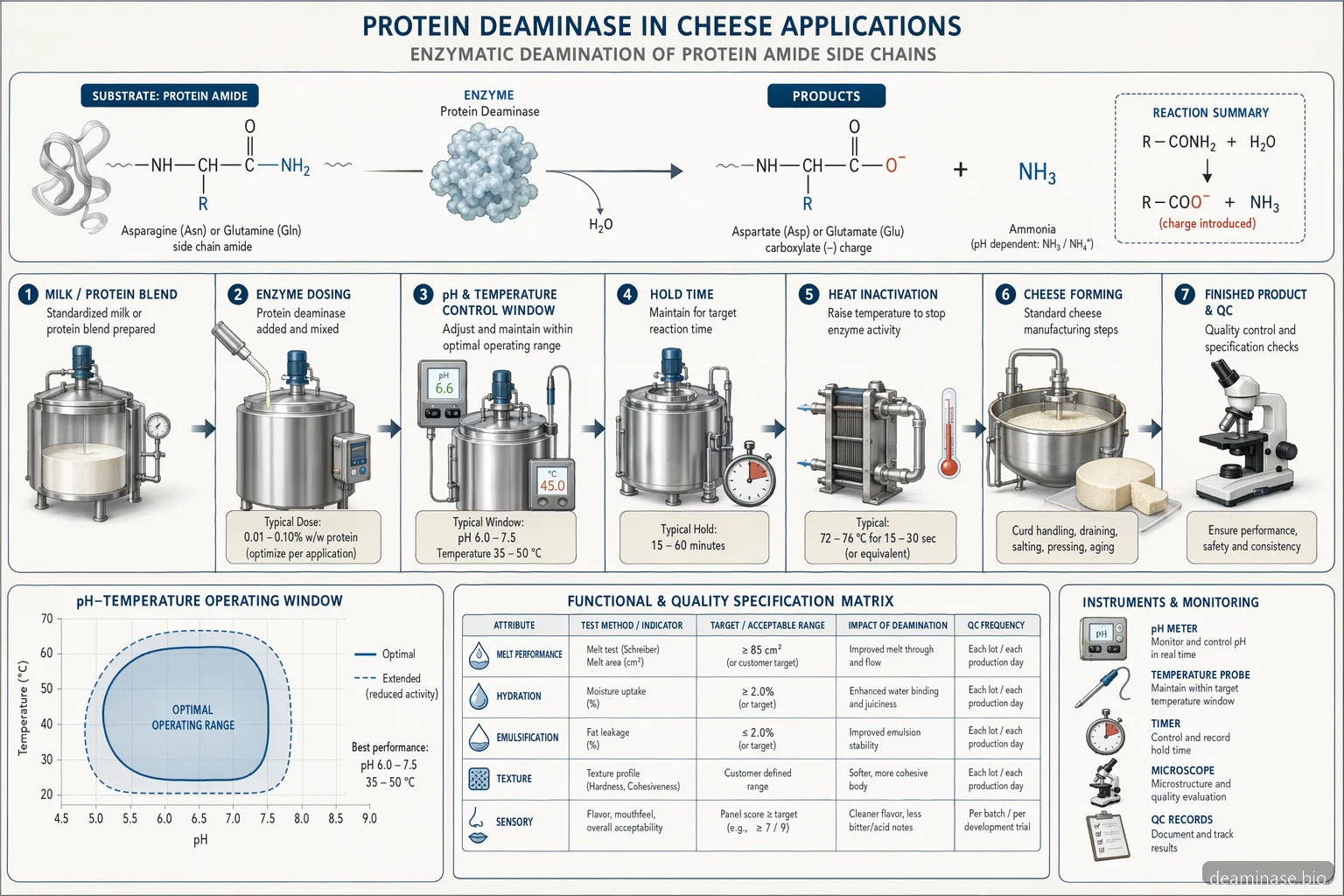
For deaminase enzyme for cheese, a practical screening window is pH 5.5-7.5 and 30-55°C, adjusted to the supplier TDS and the stability of the cheese base. Milk, caseinate, whey protein, or plant protein slurries are commonly hydrated first, then treated under agitation to avoid localized overdosing. Initial dosage screens may start around 5-50 U per gram of protein, or 0.02-0.20% enzyme preparation on protein weight when activity units are not directly comparable. Treatment times of 30-180 minutes are typical for pilot mapping, followed by thermal inactivation if the formulation and quality plan require it. In cheese milk, conditions must remain compatible with starter culture, rennet, calcium balance, and target coagulation. In processed cheese bases, the enzyme may be applied before emulsifying salts and final cook, depending on process design.
Bench screen: 3-5 dosages, one untreated control, and one process control. • Track pH drift, viscosity, ammonia formation, and heat stability. • Confirm that any inactivation step does not damage flavor or texture.
Quality Checks That Matter in Cheese
A protein deaminase supplier for cheese should support application testing with analytical guidance, because visual texture alone is not enough. Recommended QC checks include pH before and after treatment, ammonia release or degree of deamidation, moisture, fat, protein, salt, water activity, and microbiological status. Functional tests should match the finished product: melt area, oiling-off, stretch, sliceability, shred performance, spreadability, firmness, and viscosity. For natural cheese applications, measure coagulation time, curd firmness, whey losses, yield, and ripening behavior. For processed cheese, assess cook viscosity, emulsion stability, cooling curve, and reheated performance. Sensory review is essential because excessive treatment can shift taste, create bitterness perception in some protein systems, or change acid balance. A good trial report connects enzyme dosage with measurable product outcomes and cost-in-use.
Use untreated and heat-only controls for every trial set. • Record enzyme lot, activity, dosage basis, time, pH, and temperature. • Test finished product after production, cooling, and shelf-life hold.
Supplier Qualification and Documentation
When selecting a deaminase enzyme supplier for cheese, buyers should qualify both the product and the technical support behind it. Request a current Certificate of Analysis for each lot, a Technical Data Sheet with activity definition and recommended conditions, and a Safety Data Sheet for handling. Also review ingredient declaration guidance, allergen information, carrier composition, microbial limits, heavy metal specifications where applicable, storage conditions, shelf life, and country-specific food enzyme regulatory status. Avoid comparing prices only by kilograms; compare delivered enzyme activity, stability during storage, dosage required, process time, and compatibility with your production line. For multi-site cheese plants, ask whether the supplier can maintain lot consistency, provide change notifications, and support pilot trials. Supplier qualification should be completed before commercial claims, labeling decisions, or procurement scale-up.
Required documents: COA, TDS, SDS, allergen statement, and regulatory support files. • Confirm activity method and unit definition before dosage comparison. • Include packaging, storage, and shelf-life requirements in purchasing specifications.
Cost-in-Use and Scale-Up Strategy
Industrial deaminase enzyme dairy projects should be evaluated by cost-in-use, not enzyme price alone. A higher-activity product may be cheaper in operation if it reduces dosage, treatment time, rework, or formulation complexity. During scale-up, keep the same protein basis for dosage calculations and confirm that mixing, holding time, and temperature distribution match bench conditions. Production tanks often have slower heat-up, larger pH gradients, and different shear than lab beakers, which can change the reaction profile. For industrial deaminase enzyme plant protein and industrial deaminase enzyme noodles applications, lessons may transfer, but cheese trials must still validate calcium interactions, culture compatibility, melt, and flavor. A staged program is recommended: bench feasibility, 20-200 kg pilot, short production trial, shelf-life review, then supplier-approved operating limits.
Calculate enzyme cost per metric ton of finished cheese, not per kilogram of enzyme. • Include energy, holding time, inactivation, yield, and quality savings. • Lock process limits only after pilot and shelf-life validation.
Technical Buying Checklist
Buyer Questions
Protein deaminase converts selected glutamine residues in dairy or plant proteins into glutamic acid residues. In cheese systems, this can change protein charge, hydration, dispersion, emulsification, and heat behavior. The result may affect melt, spreadability, viscosity, or emulsion stability. Outcomes depend on the cheese formula, protein source, pH, calcium level, heat history, and enzyme dosage, so pilot validation is essential.
In many food enzyme contexts, protein deaminase and protein glutaminase are used to describe enzymes that deamidate protein-bound glutamine residues. Buyers should not rely on the name alone. Ask the supplier for the activity definition, substrate used in the assay, unit method, recommended pH and temperature range, and evidence that the specific product is suitable for food protein modification in cheese applications.
A practical starting screen is 5-50 U per gram of protein, or 0.02-0.20% enzyme preparation on protein weight if activity units are not directly comparable. Run an untreated control and at least three dosage points. The best dosage is the lowest level that meets melt, texture, viscosity, yield, flavor, and shelf-life requirements under your actual process conditions.
Yes, industrial deaminase enzyme plant protein trials are common when processors need better hydration, dispersion, or emulsification from soy, pea, wheat, or blended proteins. However, plant proteins vary widely in solubility, heat damage, flavor, and antinutritional components. Validate each protein source separately, then test the full cheese analogue or hybrid formula for melt, oiling-off, firmness, and sensory quality.
A qualified supplier should provide a COA for the lot, TDS, SDS, activity method, storage conditions, shelf life, allergen statement, carrier information, and applicable food regulatory documentation. For cheese processors, technical support for pilot trials is also important. Request guidance on dosage, pH, temperature, inactivation, and QC methods, then confirm performance in your own plant before commercial scale-up.
Protein-Glutaminase (Protein Deaminase) for Research & Industry
Need Protein-Glutaminase (Protein Deaminase) for your lab or production process?
ISO 9001 certified · Food-grade & research-grade · Ships to 80+ countries
Frequently Asked Questions
What does protein deaminase do in cheese processing?
Protein deaminase converts selected glutamine residues in dairy or plant proteins into glutamic acid residues. In cheese systems, this can change protein charge, hydration, dispersion, emulsification, and heat behavior. The result may affect melt, spreadability, viscosity, or emulsion stability. Outcomes depend on the cheese formula, protein source, pH, calcium level, heat history, and enzyme dosage, so pilot validation is essential.
Is protein deaminase the same as protein glutaminase?
In many food enzyme contexts, protein deaminase and protein glutaminase are used to describe enzymes that deamidate protein-bound glutamine residues. Buyers should not rely on the name alone. Ask the supplier for the activity definition, substrate used in the assay, unit method, recommended pH and temperature range, and evidence that the specific product is suitable for food protein modification in cheese applications.
What dosage should we test for industrial deaminase enzyme cheese trials?
A practical starting screen is 5-50 U per gram of protein, or 0.02-0.20% enzyme preparation on protein weight if activity units are not directly comparable. Run an untreated control and at least three dosage points. The best dosage is the lowest level that meets melt, texture, viscosity, yield, flavor, and shelf-life requirements under your actual process conditions.
Can deaminase enzyme be used with plant protein cheese?
Yes, industrial deaminase enzyme plant protein trials are common when processors need better hydration, dispersion, or emulsification from soy, pea, wheat, or blended proteins. However, plant proteins vary widely in solubility, heat damage, flavor, and antinutritional components. Validate each protein source separately, then test the full cheese analogue or hybrid formula for melt, oiling-off, firmness, and sensory quality.
What should a protein deaminase supplier provide before purchase?
A qualified supplier should provide a COA for the lot, TDS, SDS, activity method, storage conditions, shelf life, allergen statement, carrier information, and applicable food regulatory documentation. For cheese processors, technical support for pilot trials is also important. Request guidance on dosage, pH, temperature, inactivation, and QC methods, then confirm performance in your own plant before commercial scale-up.
Ready to source?
Turn This Guide Into a Supplier Brief Request a cheese application review, sample plan, and technical documentation for your protein deaminase trial.
Contact Us to Contribute