Protein Deaminase for Dairy: Specification Checklist for Industrial Buyers
Compare protein deaminase for dairy by activity, purity, process fit, COA/TDS/SDS, pilot validation, cost-in-use, and supplier qualification.
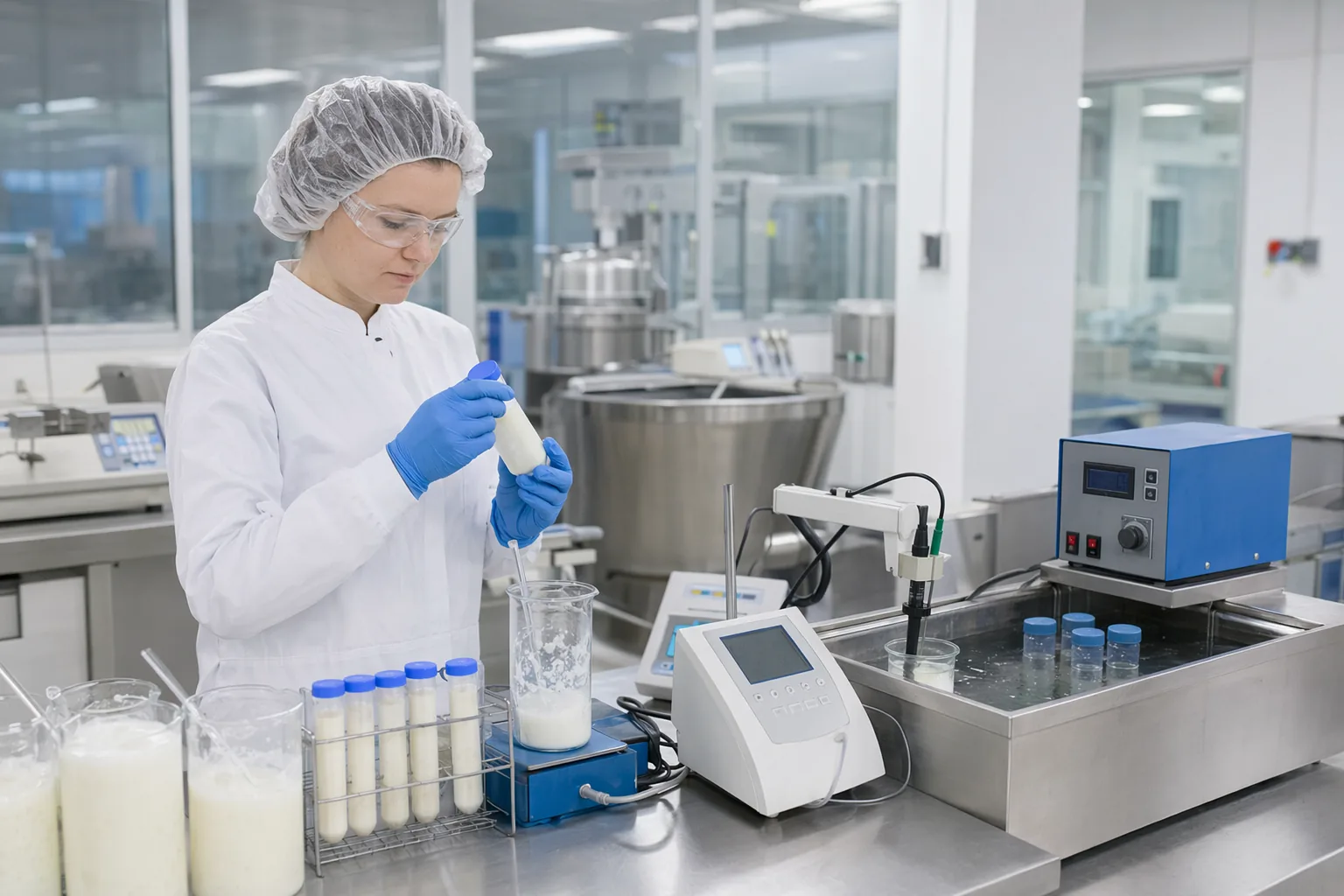
Use this B2B checklist to compare protein deaminase suppliers for dairy applications, validate processing fit, and estimate cost-in-use before scale-up.
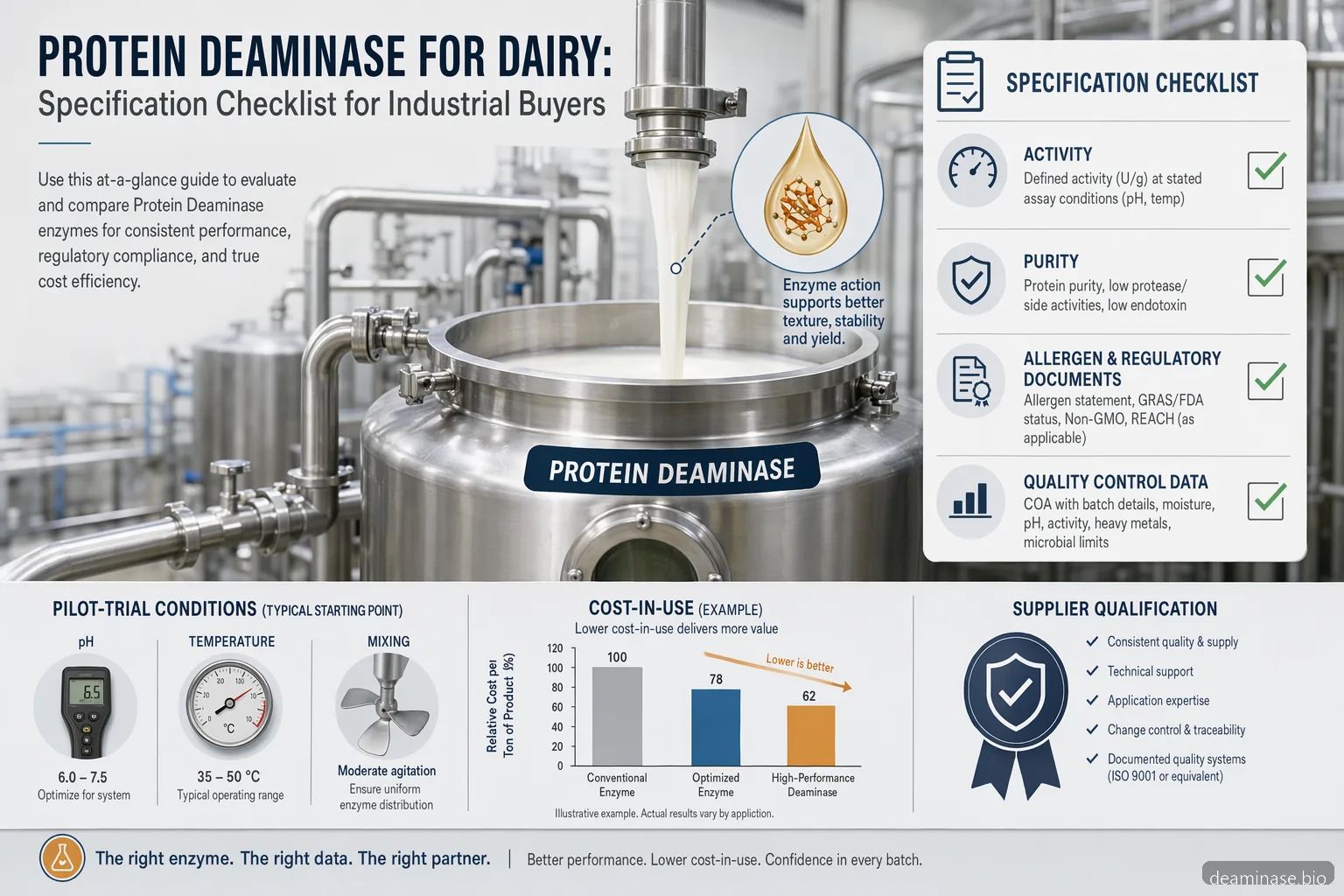
Why dairy processors compare protein deaminase specifications
Protein deaminase for dairy is used to modify protein functionality rather than to deliver a nutritional or medical effect. In dairy systems, the enzyme is commonly evaluated for controlled conversion of glutamine residues in casein, whey protein, or blended dairy proteins into glutamic acid residues. This can increase negative charge and may improve dispersion, solubility, emulsification, and interaction with water or fat phases. For industrial buyers, the practical question is not whether a deaminase enzyme is interesting in principle, but whether a specific commercial preparation performs consistently in the target product. Cheese analogs, processed cheese, high-protein beverages, dairy powders, and yogurt-style systems may all respond differently. A protein deaminase supplier for dairy should therefore provide enough technical detail to compare activity, dosage, processing window, impurity profile, documentation, and application support before procurement.
Use application trials, not only literature data, to compare suppliers. • Prioritize dairy-relevant protein substrates over generic activity claims. • Confirm whether the product is positioned for food protein modification.
Protein deaminase versus protease, transglutaminase, and other deaminases
A useful comparison starts with enzyme function. Protein deaminase, also called protein glutaminase in many food-processing contexts, mainly targets glutamine residues in proteins without intentionally hydrolyzing peptide bonds. This differs from proteases, which break peptide chains and can change viscosity, bitterness, and texture more aggressively. It also differs from transglutaminase, which crosslinks proteins and may increase gel strength. Buyers should avoid confusing industrial protein deaminase dairy applications with unrelated enzyme families. A cytidine deaminase protein acts on nucleosides, while a threonine deaminase protein is involved in amino acid metabolism; neither term describes the usual dairy processing enzyme. Academic topics such as discovery of deaminase functions by structure based protein clustering, or discovery of deaminase functions by structure-based protein clustering, are relevant to enzyme annotation, but procurement still depends on food-grade suitability, batch data, and pilot performance.
Protein deaminase modifies charge and functionality. • Protease modifies chain length and may create peptides. • Transglutaminase crosslinks proteins. • Nucleic-acid deaminases are not dairy protein-modification enzymes.
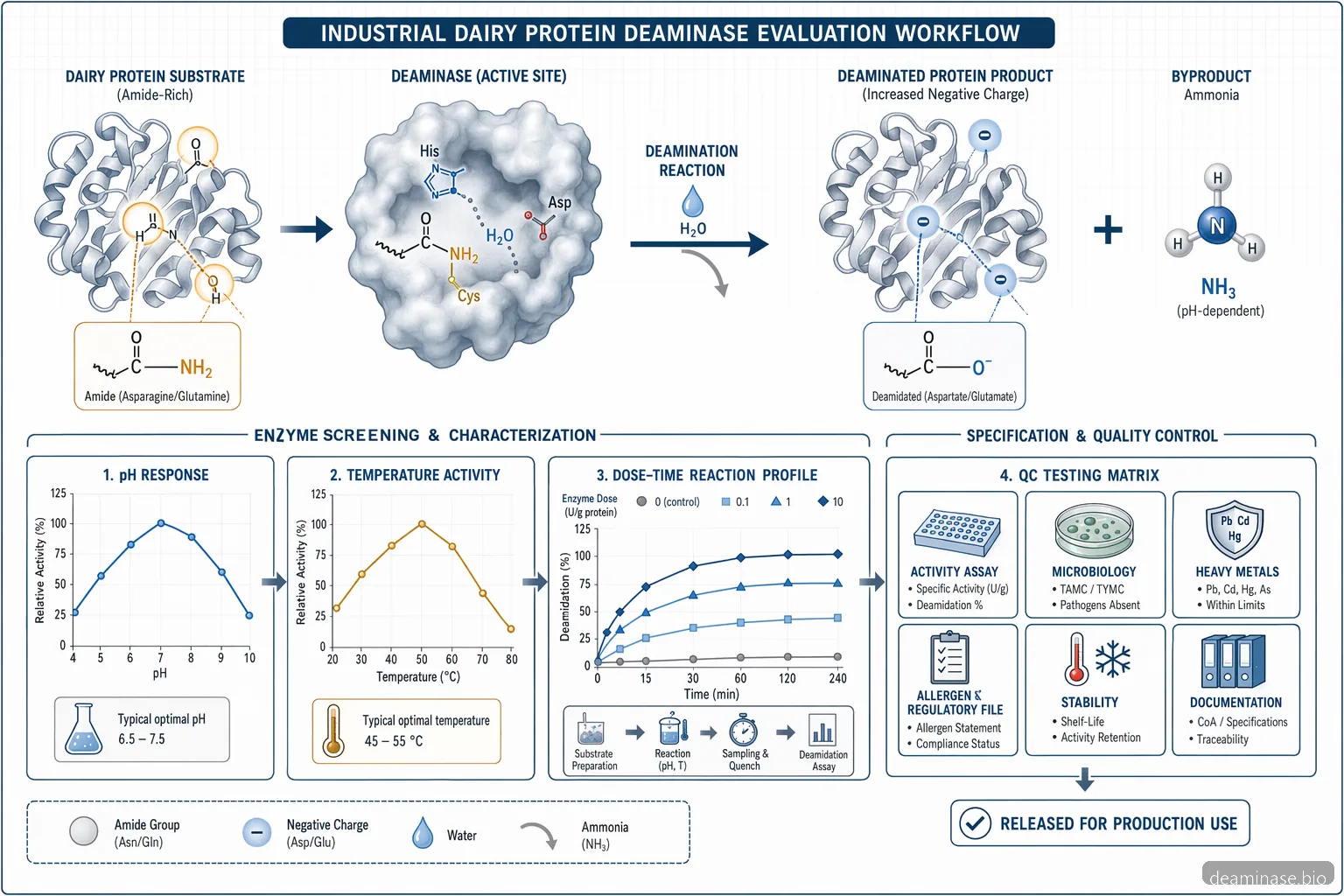
Process conditions to screen in dairy pilot trials
Initial pilot validation should define the dairy matrix, protein level, heat history, solids, salts, fat content, and downstream kill step. Where the supplier TDS allows, screening can often begin at pH 5.5-7.5 and 40-55°C, with contact times from 30 minutes to 4 hours. A practical dosage band for early trials may be 10-200 units per gram of protein, or the supplier’s recommended equivalent when activity units are defined differently. Do not compare products only by grams per tonne because enzyme preparations may use different activity assays and carriers. Monitor pH drift, viscosity, solubility, sediment, emulsion stability, sensory impact, and heat stability after pasteurization, UHT simulation, drying, or cheese-cook conditions. Enzyme inactivation should be verified under the actual thermal profile. The best industrial protein deaminase dairy trial includes a negative control, a dosage ladder, and a benchmark formulation without enzyme.
Start with supplier-recommended pH and temperature limits. • Run at least three dosage points plus a no-enzyme control. • Track both immediate and post-heat functionality. • Confirm enzyme inactivation in the real process.
Documents and QC data to request from suppliers
A protein deaminase supplier for dairy should support purchasing, QA, R&D, and regulatory review with consistent documents. Request a current Technical Data Sheet, Safety Data Sheet, and Certificate of Analysis for representative lots. The TDS should state activity definition, recommended dosage, pH range, temperature range, storage conditions, shelf life, and application notes. The COA should show lot number, activity result, microbiological limits, appearance, moisture or loss on drying when relevant, and any declared carrier or preservative information. The SDS should address safe handling, dust control, storage, and spill procedures for plant personnel. Also request allergen statements, composition disclosures appropriate for your market, and change-control expectations. Avoid relying on broad claims such as food-grade or high purity unless the supplier can connect them to measurable QC checks and your internal approval process.
COA confirms batch-specific release data. • TDS defines use conditions and activity method. • SDS supports safe industrial handling. • Change notification helps protect validated formulations.
How to evaluate cost-in-use and supplier qualification
The lowest price per kilogram is rarely the lowest cost-in-use. Compare enzyme offers by cost per kilogram of dairy protein treated at the dosage that achieves your target function. Include yield changes, rework reduction, hydration time, filtration behavior, heat stability, powder dispersibility, cleaning burden, and any formulation savings. Supplier qualification should cover manufacturing consistency, lead time, minimum order quantity, packaging format, storage temperature, technical responsiveness, and ability to provide repeat lots for validation. For strategic dairy applications, ask whether the supplier can support scale-up from benchtop to pilot plant to commercial run, including troubleshooting if the matrix contains high calcium, high sugar, stabilizers, cocoa, fruit acids, or plant-protein blends. A well-qualified supplier helps you reduce trial cycles and protects the specification after launch.
Calculate cost per kilogram of protein treated. • Include processing benefits and formulation impacts. • Check lead time, packaging, and storage requirements. • Require repeat-lot testing before full approval.
Technical Buying Checklist
Buyer Questions
Protein deaminase for dairy is used for functional modification of milk proteins, not for medical supplementation. By deamidating glutamine residues, it can change protein charge and may improve solubility, dispersion, emulsification, or heat-process behavior. The actual benefit depends on the protein source, pH, minerals, fat level, heat history, and dosage, so processors should validate performance in the intended product.
Compare suppliers by activity definition, COA consistency, TDS processing window, SDS handling guidance, side-activity profile, formulation carrier, packaging, shelf life, lead time, and technical support. Run the same dairy matrix, pH, temperature, time, and dosage ladder for each candidate. Then calculate cost-in-use per kilogram of protein treated, using the dosage that meets your functional target.
Usually no. Cytidine deaminase protein and threonine deaminase protein are different enzyme types and should not be treated as substitutes for protein deaminase used in dairy processing. The dairy-relevant product is typically described as protein deaminase or protein glutaminase for food protein modification. Always confirm enzyme identity, substrate specificity, and food-processing suitability with the supplier’s TDS and COA.
Search phrases such as protein stabilization tocagen rosetta cytosine deaminase korkegian or protein stabilization tocagen rosetta cytosine deaminase refer to specialized research contexts, not dairy ingredient purchasing criteria. For dairy procurement, focus on food-processing documentation, activity on protein substrates, practical process conditions, safety handling, lot consistency, pilot validation, and cost-in-use in your actual formulation.
Related Search Themes
protein deaminase supplier for dairy, industrial protein deaminase dairy, discovery of deaminase functions by structure based protein clustering, discovery of deaminase functions by structure-based protein clustering, cytidine deaminase protein, threonine deaminase protein
Protein-Glutaminase (Protein Deaminase) for Research & Industry
Need Protein-Glutaminase (Protein Deaminase) for your lab or production process?
ISO 9001 certified · Food-grade & research-grade · Ships to 80+ countries
Frequently Asked Questions
What is protein deaminase for dairy used for?
Protein deaminase for dairy is used for functional modification of milk proteins, not for medical supplementation. By deamidating glutamine residues, it can change protein charge and may improve solubility, dispersion, emulsification, or heat-process behavior. The actual benefit depends on the protein source, pH, minerals, fat level, heat history, and dosage, so processors should validate performance in the intended product.
How should I compare two protein deaminase suppliers?
Compare suppliers by activity definition, COA consistency, TDS processing window, SDS handling guidance, side-activity profile, formulation carrier, packaging, shelf life, lead time, and technical support. Run the same dairy matrix, pH, temperature, time, and dosage ladder for each candidate. Then calculate cost-in-use per kilogram of protein treated, using the dosage that meets your functional target.
Are cytidine deaminase protein and threonine deaminase protein relevant to dairy?
Usually no. Cytidine deaminase protein and threonine deaminase protein are different enzyme types and should not be treated as substitutes for protein deaminase used in dairy processing. The dairy-relevant product is typically described as protein deaminase or protein glutaminase for food protein modification. Always confirm enzyme identity, substrate specificity, and food-processing suitability with the supplier’s TDS and COA.
Do research phrases about cytosine deaminase help with dairy procurement?
Search phrases such as protein stabilization tocagen rosetta cytosine deaminase korkegian or protein stabilization tocagen rosetta cytosine deaminase refer to specialized research contexts, not dairy ingredient purchasing criteria. For dairy procurement, focus on food-processing documentation, activity on protein substrates, practical process conditions, safety handling, lot consistency, pilot validation, and cost-in-use in your actual formulation.
Related: Protein Deamination for Better Food Functionality
Turn This Guide Into a Supplier Brief Request a dairy application review, COA/TDS/SDS package, and pilot-trial dosage plan for protein deaminase. See our application page for Protein Deamination for Better Food Functionality at /applications/protein-deamination-applications/ for specs, MOQ, and a free 50 g sample.
Contact Us to Contribute