Protein Deaminase Supplier for Cheese Applications
Source protein deaminase for cheese with process conditions, QC checks, COA/TDS/SDS review, pilot validation, and cost-in-use guidance.
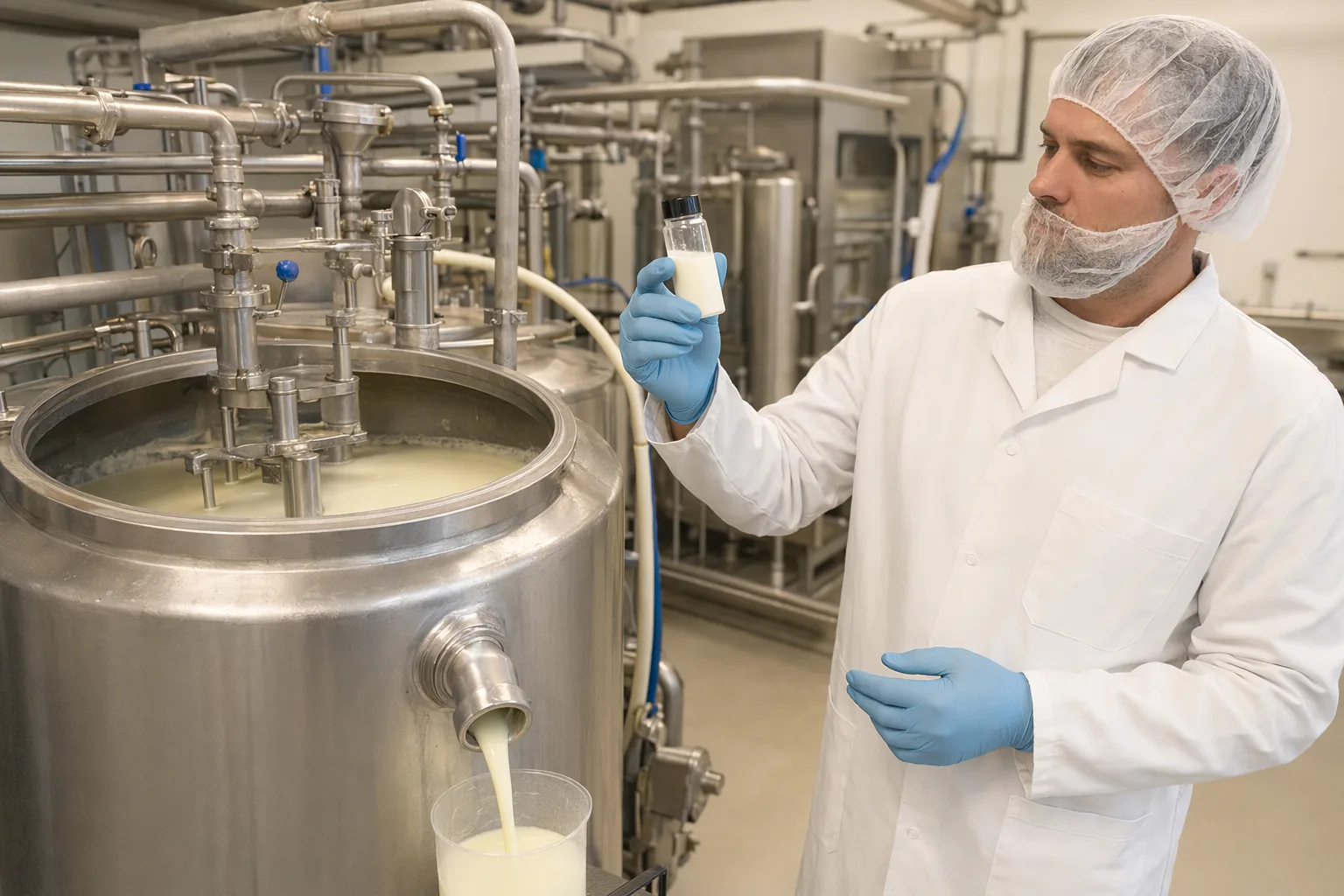
A practical sourcing guide for cheese manufacturers evaluating protein deaminase, also known as protein glutaminase, for functionality, process fit, and cost-in-use.
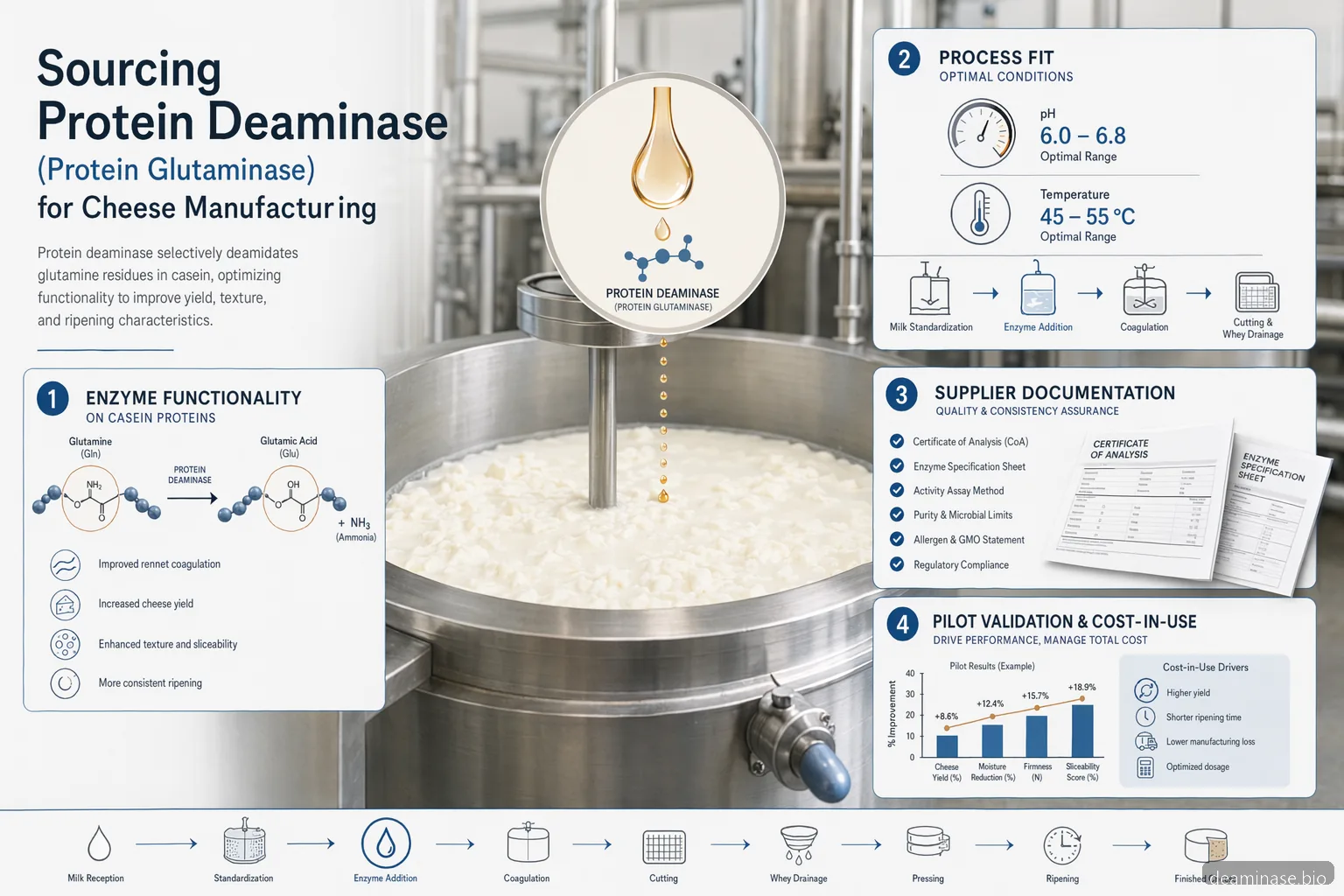
Why Cheese Manufacturers Use Protein Deaminase
Protein deaminase, often supplied as protein glutaminase, modifies glutamine residues in food proteins by converting amide groups to carboxyl groups. In cheese systems, this can change protein charge, hydration, dispersion, and interaction with fat, salts, and water. For industrial buyers, the value is not simply enzyme activity; it is whether the deaminase enzyme creates measurable performance in processed cheese, cheese spreads, recombined cheese, cheese analogs, or dairy-protein blends. A protein deaminase supplier for cheese should be able to explain how the enzyme behaves with casein, whey proteins, milk protein concentrates, and mixed dairy-plant systems. The best starting point is a defined process objective: smoother texture, improved emulsification, better water binding, reduced graininess, or more stable melt. Results depend on substrate, pH, heat history, salt system, fat level, and processing shear.
Common targets include texture control, emulsification support, and protein dispersion. • Use should be validated for each cheese type and formulation. • Protein modification must align with regulatory and labeling requirements in the target market.
Typical Process Window for Cheese Trials
A qualified protein glutaminase supplier for cheese should provide a TDS with recommended activity units, pH range, temperature range, substrate concentration, and inactivation guidance. For early screening, many cheese and dairy protein trials are run near pH 5.5 to 7.0, with temperatures around 35 to 55°C, and holding times from 30 to 180 minutes, depending on enzyme activity and matrix viscosity. Dosage may be screened in bands such as 5 to 50 U per gram of protein, or according to the supplier’s declared activity method. These are starting points, not universal specifications. In a cheese process, the enzyme can be added to a milk protein slurry, cheese milk, rework blend, or pre-emulsified cheese base, depending on the application. Heat inactivation is commonly evaluated during pasteurization, cooking, or processed cheese heating steps.
Screen pH, temperature, time, and dosage together rather than one variable at a time. • Confirm enzyme inactivation under your actual heat profile. • Track viscosity during reaction because hydration changes can affect pumping and mixing.
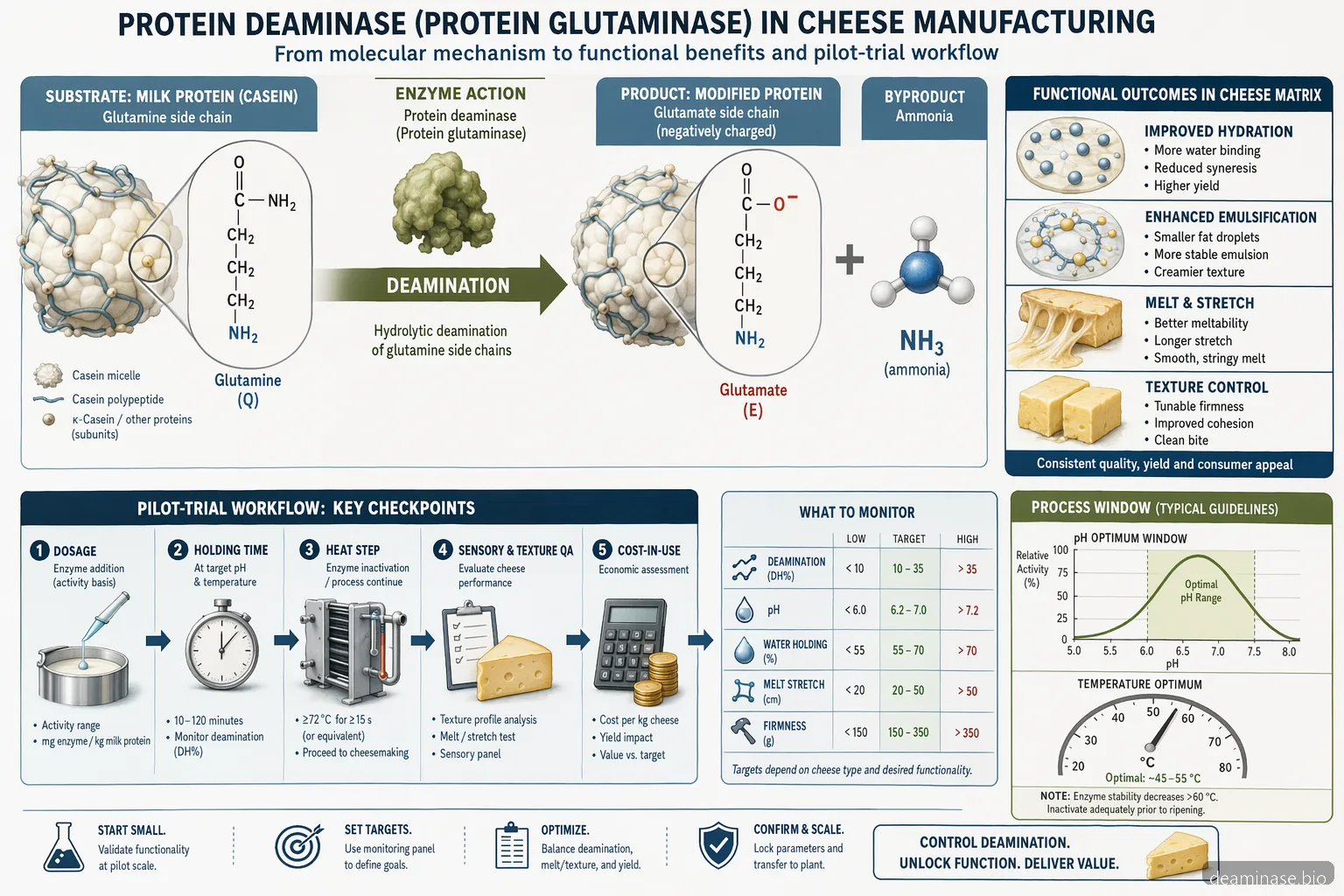
Supplier Documents Buyers Should Request
For B2B qualification, the enzyme sample is only one part of the decision. Request a current COA for the lot supplied, a technical data sheet, and a safety data sheet before plant testing. The COA should identify activity, lot number, manufacturing date or retest date, appearance, and relevant quality limits. The TDS should describe enzyme function, recommended storage, solubility or dispersion method, application guidance, and activity assay basis. The SDS should support safe handling, dust control, PPE selection, spill response, and storage precautions. A deaminase enzyme supplier for cheese should also provide allergen information, carrier or stabilizer declaration, country of origin if needed, and documentation needed for your internal approval workflow. Do not rely on generic activity claims without knowing the assay method, because enzyme units may not be comparable across suppliers.
Request COA, TDS, SDS, allergen statement, and composition guidance. • Check whether the declared activity method matches your comparison protocol. • Confirm storage temperature, shelf life, and retest policy.
Pilot Validation Before Commercial Purchase
Pilot validation should reproduce the intended cheese process as closely as possible, including mixing order, hydration time, pH adjustment, calcium and emulsifying salt levels, thermal profile, shear, and cooling rate. For a protein deaminase supplier for cheese, strong technical support means helping design a trial matrix that can separate enzyme effects from normal process variation. Run an untreated control, a heat-inactivated enzyme control if practical, and at least three dosage levels. Measure degree of deamidation where possible, often through ammonia release or a validated external method, and pair it with practical cheese tests. Useful checks include pH, moisture, water activity, viscosity, melt, oiling-off, firmness, sliceability, spreadability, flavor, and storage stability. Sensory review is important because excessive modification may affect flavor release or texture. Scale-up should confirm that reaction time and heat transfer remain consistent.
Use controls and replicated batches when possible. • Evaluate both fresh and aged or stored samples. • Document the final reaction stop point and inactivation step.
Cost-in-Use and Commercial Evaluation
Industrial enzyme purchasing should compare total cost-in-use rather than price per kilogram. A lower-priced enzyme preparation may require higher dosage, longer holding time, more rework, or tighter storage control. A higher activity product may be more economical if it reduces formulation cost, improves yield, stabilizes texture, or enables use of alternative protein streams. For cheese applications, calculate enzyme cost per metric ton of finished product and compare it with measurable process benefits such as reduced rejects, improved water binding, lower emulsifying salt adjustment, or better consistency in high-protein bases. A protein deaminase supplier for dairy should also be assessed on lead time, sample responsiveness, technical troubleshooting, packaging suitability, and lot consistency. The final purchase decision should include performance data from pilot runs, document review, supply reliability, and internal quality approval.
Calculate cost per ton of finished cheese, not only enzyme unit price. • Include process time, yield, rejects, and formulation savings. • Confirm packaging size and storage fit for plant operations.
Related Applications Beyond Cheese
Many buyers evaluating industrial protein deaminase cheese trials also consider the same enzyme platform for other protein systems. A protein deaminase supplier for plant protein may support soy, pea, wheat, or mixed protein beverages and analog cheese bases where dispersion and emulsification are key challenges. A deaminase enzyme supplier for plant protein should provide separate application data because plant protein isolates differ from casein in solubility, denaturation history, and off-flavor profile. For noodles, a protein deaminase supplier for noodles may focus on dough handling, hydration, texture, or cooking quality, but validation conditions will differ from dairy. If your company operates across cheese, dairy, plant protein, and noodles, ask whether the supplier can support multi-application screening with consistent analytical methods. This improves comparison quality and avoids overextending data from one matrix to another.
Do not transfer cheese dosage directly to plant protein or noodles. • Request matrix-specific application notes and trial protocols. • Use the same QC framework where possible for cross-application comparison.
Technical Buying Checklist
Buyer Questions
In many food enzyme discussions, protein deaminase refers to protein glutaminase activity that deamidates glutamine residues in proteins. Suppliers may use different naming conventions, so buyers should confirm the enzyme function, substrate specificity, declared activity method, and food application guidance. For cheese trials, the important point is whether the enzyme produces the target protein modification in your dairy matrix under your process conditions.
Dosage should be based on the supplier’s activity units and your protein content. As an early screen, some teams evaluate several levels around 5 to 50 U per gram of protein, but this is not a universal recommendation. Always review the TDS, confirm the assay basis, and test against untreated controls. Final dosage should be selected by functionality, inactivation, sensory quality, and cost-in-use.
At minimum, request a COA for the supplied lot, a TDS, and an SDS. Most cheese manufacturers also need allergen information, composition or carrier guidance, storage conditions, shelf life, lot traceability, and application support data. Supplier qualification should verify that documents are current, consistent with the sample, and suitable for your internal quality, regulatory, procurement, and plant safety review.
Inactivation should be validated under the actual thermal profile used in your process, not assumed from a generic temperature statement. Test residual activity where practical, or compare functional stability before and after heating during storage. Pasteurization, cooking, and processed cheese heating steps may be sufficient, but the result depends on time, temperature, matrix solids, pH, and equipment heat transfer.
Yes, but application data should be matrix-specific. A protein deaminase supplier for plant protein, dairy, cheese, and noodles should provide separate trial guidance because pH, substrate accessibility, hydration, heat history, and desired texture are different. Multi-application support is valuable when the supplier uses clear activity methods, responsive technical service, and consistent documentation across product lots.
Protein-Glutaminase (Protein Deaminase) for Research & Industry
Need Protein-Glutaminase (Protein Deaminase) for your lab or production process?
ISO 9001 certified · Food-grade & research-grade · Ships to 80+ countries
Frequently Asked Questions
Is protein deaminase the same as protein glutaminase for cheese?
In many food enzyme discussions, protein deaminase refers to protein glutaminase activity that deamidates glutamine residues in proteins. Suppliers may use different naming conventions, so buyers should confirm the enzyme function, substrate specificity, declared activity method, and food application guidance. For cheese trials, the important point is whether the enzyme produces the target protein modification in your dairy matrix under your process conditions.
What dosage should we test for protein deaminase in cheese?
Dosage should be based on the supplier’s activity units and your protein content. As an early screen, some teams evaluate several levels around 5 to 50 U per gram of protein, but this is not a universal recommendation. Always review the TDS, confirm the assay basis, and test against untreated controls. Final dosage should be selected by functionality, inactivation, sensory quality, and cost-in-use.
What documents are needed to qualify a deaminase enzyme supplier for cheese?
At minimum, request a COA for the supplied lot, a TDS, and an SDS. Most cheese manufacturers also need allergen information, composition or carrier guidance, storage conditions, shelf life, lot traceability, and application support data. Supplier qualification should verify that documents are current, consistent with the sample, and suitable for your internal quality, regulatory, procurement, and plant safety review.
How do we confirm protein deaminase is inactivated in a cheese process?
Inactivation should be validated under the actual thermal profile used in your process, not assumed from a generic temperature statement. Test residual activity where practical, or compare functional stability before and after heating during storage. Pasteurization, cooking, and processed cheese heating steps may be sufficient, but the result depends on time, temperature, matrix solids, pH, and equipment heat transfer.
Can the same supplier support cheese, plant protein, dairy, and noodles?
Yes, but application data should be matrix-specific. A protein deaminase supplier for plant protein, dairy, cheese, and noodles should provide separate trial guidance because pH, substrate accessibility, hydration, heat history, and desired texture are different. Multi-application support is valuable when the supplier uses clear activity methods, responsive technical service, and consistent documentation across product lots.
Related: Protein Deamination for Better Food Functionality
Turn This Guide Into a Supplier Brief Request a COA/TDS/SDS review and pilot trial plan for protein deaminase in your cheese process. See our application page for Protein Deamination for Better Food Functionality at /applications/protein-deamination-applications/ for specs, MOQ, and a free 50 g sample.
Contact Us to Contribute